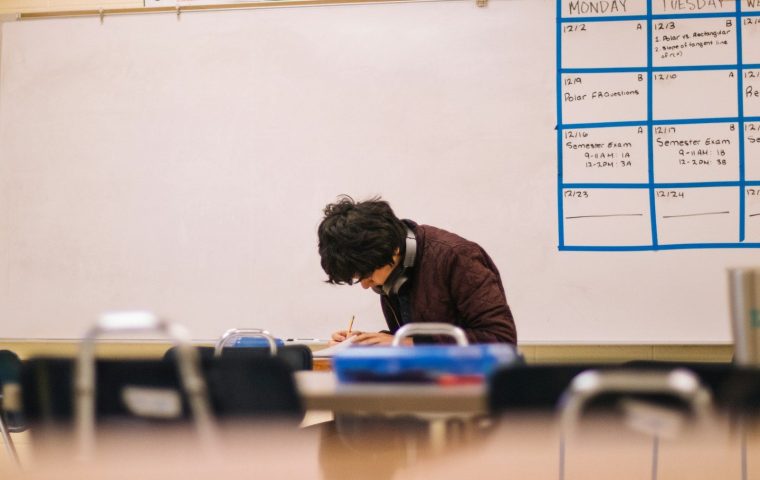


It usually hits on a Sunday night. You are cleaning out your bag, you pull out two syllabi, and you notice the dates almost stacked on top of each other. Biology on Tuesday. Statistics on Thursday. Same week, and suddenly the couch feels very far away.
I have sat across from hundreds of students in that exact moment. The panic is real, but it is also a little misleading. Two exams in one week is not a crisis. It is a scheduling problem wearing a scary costume.
Once you treat it as scheduling instead of doom, your shoulders drop and your brain starts working again. Let me walk you through how to do that, step by step.
Start by mapping the week, not the material
Your first instinct is probably to open a textbook. Resist for ten minutes. The most useful thing you can do now is see the whole week on one page.
Grab a blank sheet or a calendar app and block out every commitment you already have. Classes, your shift, the gym, the two hours you always lose to dinner and scrolling. What remains is your actual study budget, and it is almost always smaller than you imagined.
Now count backward from each exam. If biology is Tuesday morning, your prep window closes Monday night, which stops you from mentally spending time you do not have.
Write the two exam dates at the top of the page in a color that stands out. When you can literally see the finish lines, your planning gets honest fast, and honest planning is calm planning.
Split your time by difficulty, not by fairness
Students love to divide study time down the middle, fifty-fifty, because fairness feels safe. It is usually the wrong call.
Your time should follow the gap between where you are and where you need to be. If you are solid in statistics and shaky in biology, biology earns more hours. That is triage, not favoritism.
Do a quick honesty check. Ask what grade you would get if the exam were tomorrow, and how much it matters to your final. The subject that is both weak and heavily weighted gets first pick of your best hours.
| Study approach | Best when | Watch out for |
|---|---|---|
| Block scheduling (one subject per day) | The two subjects are very different, like an essay exam and a math exam | Long gaps between sessions can let earlier material fade |
| Alternating (switch subjects each session) | Both exams are memory-heavy and close together | Switching too often can leave every topic half-finished |
| Weighted split (more hours to the harder exam) | One subject is clearly weaker or worth more points | Neglecting the "easy" exam until it quietly becomes a problem |
Most people land on a blend, giving biology the heavier share while still touching statistics daily so it stays warm.
Protect your recall with short, spaced sessions
Cramming two subjects back to back feels productive, but your memory does not reward marathon sessions the way it rewards repetition. This is where spaced repetition explained simply earns its keep during a double-exam week.
The idea is small and powerful. Instead of reviewing biology once for three hours, you review it three times for one hour, spread across different days. Each time you revisit the material, the memory sets a little deeper.
When two subjects compete for your attention, spacing does double duty. Touching each subject daily, even briefly, keeps both alive so you are never restarting from zero.
Build the plan on paper before you trust it
A plan that lives only in your head will lie to you. It always feels more doable than it is. Writing it down turns wishful thinking into something you can check against reality.
If you have never set one up, learning how to build a weekly study schedule is worth the twenty minutes it takes. For a two-exam week, keep it simple. Name the subject, the topic, and the time window for each session, and nothing more.
Then do the part most students skip. Add up the hours you assigned and compare them to the hours you actually have. If your plan needs 18 hours and your week holds 11, you have not made a schedule. You have made a wish, and better to know now.
Use active recall so review actually sticks
Rereading notes is the comfort food of studying. It feels warm and familiar, and it does surprisingly little. Your brain confuses recognizing the material with knowing it, and that gap shows up on exam day.
Active recall flips the process. Instead of looking at the answer, you force yourself to produce it first, then check. Close the notebook and explain photosynthesis out loud. Cover the formula and rewrite it from memory. Struggling to retrieve something is the exact moment learning happens.
This matters even more with two exams, because your study time is tight and you cannot afford fake progress. To sharpen the method, our guide on how to study for exams effectively goes deeper on turning passive review into real retention.
A simple retrieval routine
Read a section once, close everything, and write down what you remember. Then reopen the material, mark what you missed, and make those gaps your study list.
Manage the panic, not just the pages
Two exams in one week strains your nerves as much as your calendar. A stressed brain remembers less, so we plan for it on purpose.
Sleep is not the thing you sacrifice. It is the tool that makes the studying stick, especially the night before each exam. A rested brain recalls more than a tired one that squeezed in two extra hours.
Between the two test days, run a tiny reset. A walk, a shower, ten minutes of nothing. You are not behind for resting. You are clearing space so the second subject has somewhere to land.
What to do the night before each exam
By the evening before a test, heavy new learning is mostly behind you. This is not the time to open a fresh chapter, but to consolidate and calm down.
Do a light pass over your weak spots, the specific gaps your recall practice flagged, then set out what you need for the morning and let yourself stop. Confidence the night before comes from a good plan carried out, not from one last frantic hour.
Should I study both subjects every day or focus on one at a time?
Give one subject the main focus each day, but spend at least ten or fifteen minutes on the other so it stays fresh. Full separation is fine only when the exams are days apart and very different in format.
The exams are only one day apart. How do I split the last 48 hours?
Spend the bulk of the final day before each exam on that exam, and use the earlier day to lock in the first subject while lightly warming up the second. Protect sleep both nights, because a tired brain undoes the extra hours.
What if I realize there is not enough time to cover everything?
Triage by weight and payoff. Study the topics most likely to appear and worth the most points first, accept that you will not master every detail, and aim for solid partial coverage rather than perfect coverage of one subject and none of the other.
Here is what I want you to hold onto. A stacked exam week feels overwhelming because you are seeing all of it at once, but you will never take both tests in the same moment. Make the plan, protect your sleep, quiz yourself honestly, and trust the steady version of you that shows up on exam morning. You have got this.