

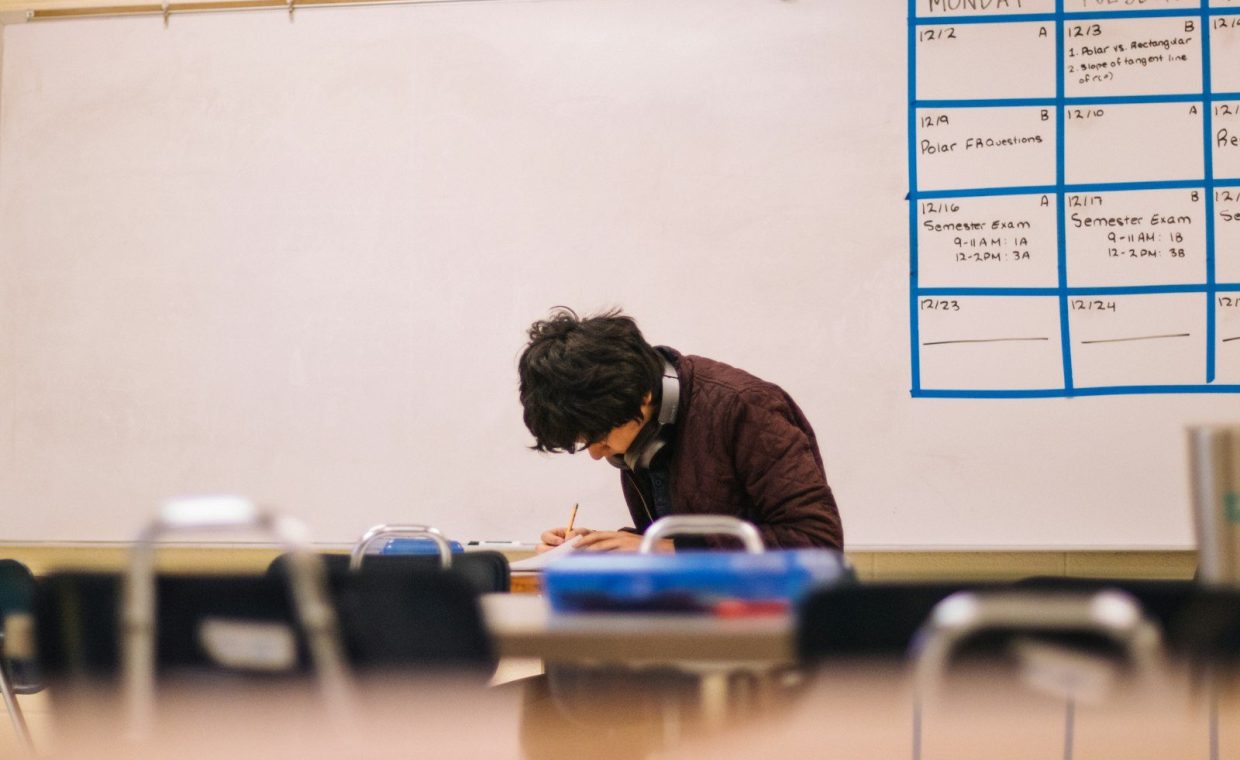
The first time I watched my younger brother prepare for finals, he had three energy drinks lined up on his desk like a tiny army and a stack of untouched notes from September. It was 11pm the night before his biology exam. By 2am he was crying over the same diagram he had read forty times without remembering any of it.
He passed, barely, and swore he would never do it again. He did it again the next semester. And the one after that.
If that sounds painfully familiar, I want you to know the problem is almost never that you are lazy or bad at studying. It is that nobody handed you a system that runs quietly in the background of a normal busy week. So let us build one together, step by step.
Map the term backward from your exam dates
Before you study a single fact, you need to know how much runway you actually have. Cramming happens because the exam arrives as a surprise, even though it was on the syllabus all along.
Open your calendar and write in every exam date for the term. Then count back. If you have around twelve weeks until finals, you have roughly ten usable study weeks once you subtract the chaos of the first and last weeks.
Now divide. A typical course might need 15-20 hours of review spread across the term. Spread over ten weeks, that is under two hours a week per subject. Suddenly the mountain looks like a set of small, walkable hills.
Your brain remembers things far better when learning is spaced out over time instead of crammed into one block. Ten short sessions beat one long panic almost every time.
Build a fixed weekly study block you actually keep
A plan that lives only in your head is a wish. A plan that lives in your calendar is an appointment. Pick specific windows, the same ones each week, and protect them the way you would protect a shift at work.
I suggest two to four blocks of 45-60 minutes across the week. Tuesday at 7pm. Thursday after lunch. Sunday morning with coffee. The exact times matter less than the fact that they repeat.
Make the block frictionless
Decide in advance where you will sit, what you will study, and what you will close (yes, the phone goes in another room). The fewer decisions you face when the block begins, the more likely you are to actually start.
Attach your study block to something you already do daily. "After I eat dinner, I review for 45 minutes" is far stickier than "I will study sometime later."
Turn your messy notes into something testable
Most students study by rereading. Rereading feels productive because the words start to look familiar, but familiarity is not the same as knowing. You want notes you can quiz yourself from, not just read.
This is where the format of your notes earns its keep. If your pages are a wall of transcribed sentences, they are hard to test against. Switching to one of the cleaner note-taking methods that organize ideas into questions and cues makes the next step almost automatic.
At the end of each lecture or reading, write three or four questions a future version of you should be able to answer. That tiny habit converts passive notes into a study tool before you even start revising.
Use active recall as your main study move
Here is the single change that helps anxious students the most: stop rereading and start retrieving. Close the book, then try to pull the answer out of your own head. The struggle to remember is exactly what strengthens the memory.
In practice this looks like flashcards, blank-page brain dumps, or answering those questions you wrote in Step 3 without peeking. It feels harder than rereading, and that discomfort is the point. If you want the full method, this guide to the active recall study technique and how to apply it walks through it carefully.
Highlighting and recopying notes feels like studying but mostly keeps your hands busy. If you finish a session and never tested yourself, you mostly rehearsed recognition, not recall.
A simple session shape
- Spend five minutes reviewing what you covered last time.
- Spend the bulk of the block testing yourself on new material.
- Mark anything you got wrong so it comes back next session.
Bring back old material on a rotation
The reason cramming fails is that facts learned once fade fast. The fix is to revisit material right as you are about to forget it, which keeps pulling it back into long-term memory.
You do not need fancy software for this. A simple rotation works: review new material this week, then revisit it again two weeks later, then once more before the exam.
| When | What you do | Time needed |
|---|---|---|
| Same week | Learn and self-test new material | 45-60 min |
| About 2 weeks later | Quick recall of the same topic | 20-30 min |
| Week before exam | Final pass on weak spots only | 30-45 min |
Notice that each revisit takes less time. Topics you know well drop off quickly, and your hours flow toward the things that still trip you up.
Run a calm dress rehearsal, not a panic
In the final week, your job is not to learn new things. It is to rehearse performing under exam conditions, which is a different skill from knowing the material.
Sit down with a past paper or a set of practice questions and a timer. No notes. When the time is up, mark yourself honestly and study only the gaps you found. This turns vague dread into a short, specific to-do list.
Practicing under timed conditions teaches your body that the exam room is familiar territory. A lot of test anxiety is really just the shock of an unfamiliar situation, and rehearsal removes most of that shock.
What to do when you have already fallen behind
Let us be honest. Some of you are reading this two weeks before an exam with eight weeks of backlog. The weekly system still helps, you just compress it.
Triage first. List every topic and mark each one green (solid), yellow (shaky), or red (no idea). Spend almost all your time on the reds and yellows, and resist the urge to keep polishing the greens because they feel comfortable.
Then protect your sleep anyway. A rested brain that studied four focused hours will outperform an exhausted one that "studied" nine. This same clear-eyed prioritizing helps with bigger decisions too, like figuring out how to choose a college major that fits your strengths instead of drifting into one by default.
Map your dates, book repeating blocks, write testable notes, study by recalling not rereading, revisit old topics on a rotation, and finish with a timed rehearsal. None of it happens at 2am.
How many hours a week should I really study to avoid cramming?
For most courses, two to three focused hours per subject each week is plenty when you start early. The number matters less than consistency. Three calm hours every week beats a single twelve-hour binge before the exam, because spaced practice is what actually moves information into long-term memory.
I keep skipping my planned study blocks. How do I stay consistent?
Shrink the block until it feels almost too easy to skip, even just twenty minutes, and attach it to a habit you already have like dinner or your morning coffee. Track whether you showed up rather than how perfectly it went. Consistency compounds, and a short session you actually do beats an ambitious one you keep postponing.
Is cramming ever worth it the night before?
A short, calm review the night before can settle your nerves and refresh a few facts. The problem is learning everything for the first time at midnight, which wrecks your sleep and your recall. If you have a weekly system running, the night before becomes a light glance, not a desperate rescue mission.
Start with the smallest piece. Put your exam dates in the calendar tonight and book one repeating study block for this week. That single move is what separated my brother's frantic semesters from the steady one he finally pulled off. You can build the rest one quiet week at a time, and your future self, the one not crying over a diagram at 2am, will be very grateful.