

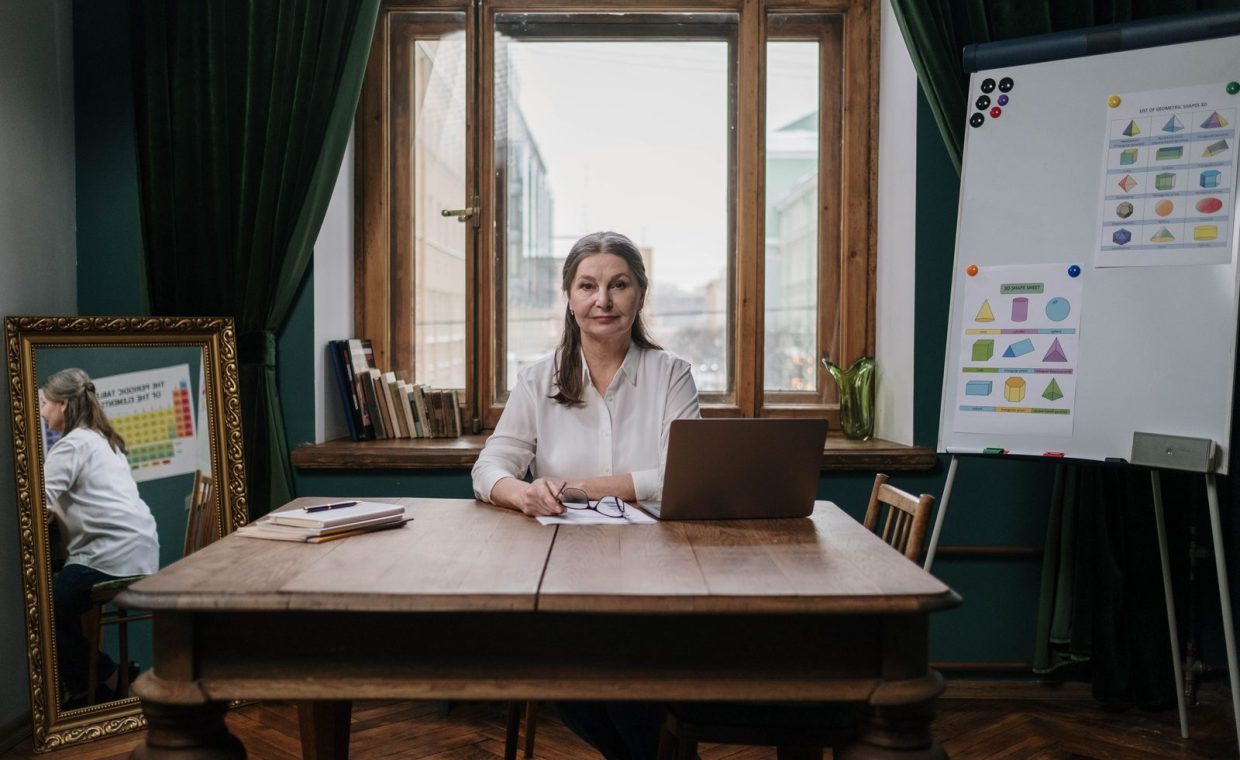
Dana taught seventh-grade English for nine years before she quit. The thing she remembers most clearly is not the decision itself. It is the Sunday night in February when she opened her grade book, saw 140 essays waiting, and felt nothing. Not dread. Just flatness.
She was 34, had a mortgage, and had never written a line of code. Eighteen months later she started a job as a junior UX designer at a mid-size software company in Columbus. The salary was about 18 percent higher than her teaching pay, with a remote schedule and a manager who did not email her at 9pm.
I talked to Dana because her path is the kind people romanticize and then get wrong. There was no overnight bootcamp miracle. There was a slow, slightly anxious slog with a lot of unglamorous practice. Here is how it actually went.
Why a teacher is closer to UX than she thinks
Dana assumed she was starting from zero. She was not, and neither are most teachers who consider this jump.
UX design is mostly about understanding humans, watching them struggle with something, and quietly fixing the thing so they stop struggling. Teachers do a version of that every single day. You explain a concept, you watch twelve confused faces, you change the explanation. That is iteration. That is user research with worse coffee.
The technical tools were genuinely new to her. But the underlying instinct, paying attention to where people get stuck and not blaming them for it, was already wired in. This is the difference between soft skills versus the hard, teachable ones. Dana had the soft layer cold. She just needed the hard layer on top.
Empathy, clear communication, and the patience to explain something three different ways are not "nice to have" in UX. Hiring managers test for them in interviews. Teachers tend to have them in abundance and undersell them on their resumes.
The first six months: learning in the cracks
Dana did not quit her job to learn. That is the part people skip when they tell these stories. She kept teaching and studied at night, which was exhausting and, in her words, "the only responsible version of this."
She started with a single online course on UX fundamentals, the kind that runs around 20 hours of video. She finished it in about six weeks because she could only carve out an hour after dinner.
Her early mistake was collecting courses like trading cards. She bought four, finished one. Eventually she made a rule: no new course until she had built something with the last one.
Pick one foundational course and do not buy another until you have produced a real artifact from it, a wireframe, a redesign, a clickable prototype. Course-hoarding feels like progress. It is not. Output is progress.
By month four she had taught herself Figma well enough to be dangerous. By month six she had three small projects, all redesigns of apps that annoyed her, including her own school's parent-communication portal, which was genuinely terrible.
Building a portfolio when you have no clients
This is where most career switchers stall. You need a portfolio to get hired, and you need to be hired to have real work. It is a small chicken-and-egg trap.
Dana broke it with what designers call spec work and self-directed projects. She picked three problems she actually understood and designed solutions, then wrote up her thinking like a case study.
The school portal project became her strongest piece, not because the visuals were stunning, but because she could explain the problem better than anyone. She had lived it. She interviewed eight other teachers (free user research, technically) and documented what she heard.
"Recruiters did not care that the app was fake," Dana told me. "They cared that I could explain why I made each decision. The teaching background is what made me good at that part."
A useful detail: she treated each case study like a lesson plan. Problem, approach, what worked, what she would change. Hiring managers told her later that the clarity stood out in a stack of portfolios full of pretty screens and no reasoning.
What the timeline actually looked like
People want a tidy month-by-month map. Real reskilling is messier than that, but here is the honest shape of Dana's eighteen months.
| Phase | Roughly when | What she did |
|---|---|---|
| Foundations | Months 1-3 | One core course, basic Figma, lots of reading |
| First builds | Months 4-7 | Three self-directed redesigns, learned by doing |
| Portfolio polish | Months 8-11 | Wrote case studies, got feedback from designers online |
| Network and apply | Months 12-15 | Coffee chats, one freelance gig, dozens of applications |
| Landing it | Months 16-18 | Interviews, a take-home test, the offer |
Notice that applying did not start until month twelve. Dana resisted the urge to apply early and rack up rejections that would have dented her confidence before she was ready.
The mistakes she would warn you about
Dana is refreshingly blunt about what wasted her time, and I appreciate a person who will name their own missteps.
- Chasing trends instead of fundamentals. She spent two weeks on a flashy animation tool she never used again. Learn the boring core first.
- Treating certificates as the finish line. A certificate gets you a conversation, not a job. The portfolio does the heavy lifting.
- Going silent online. She lurked for months before posting work. The feedback she got once she started sharing was worth more than another course.
Do not assume a single bootcamp guarantees a job. The good ones teach you well. None of them can hand you the months of deliberate practice and portfolio work that actually convince a hiring manager. Treat any program as a starting line, not a finish line.
One more thing she learned the slow way: a related field can shorten the runway. Dana picked up basic digital marketing skills aimed at beginners while studying UX, mostly to understand how products get in front of users. That context made her a more useful designer and gave her something to talk about in interviews beyond pixels.
Staying current after you land the role
Getting hired is not the end of the learning. Design tools shift, and the credential you earned in month three can feel dated by month thirty.
Dana sets aside a few hours each month to keep her skills and any certifications from going stale. If you earned credentials along the way, it pays to know how to keep certifications current rather than letting them quietly expire on your resume.
She also kept the habit that got her here: build something small and real on a regular basis. The portfolio that got her hired is not the portfolio she shows now. It grows.
Your existing skills count. Teaching, support work, and any job built on explaining things give you a real head start on the human side of design.
Pick one course, finish it, and build something before buying the next. Output beats collection every time.
The portfolio, not the certificate, gets you hired. Explain your reasoning, not just your screens.
Keep studying after the offer. Tools and credentials age, and a few hours a month keeps you from going stale.
Do I need to quit my job to reskill into UX?
No, and most people should not. Dana kept teaching and studied at night for the full eighteen months. It was tiring, but it removed the financial pressure that pushes people to take the first weak offer they get.
How long does reskilling into UX realistically take?
Eighteen months part-time is a fair benchmark for someone starting from scratch. Full-time learners sometimes move faster, but the portfolio and networking phases are hard to rush no matter how many hours you put in.
Is a UX certificate enough to get hired?
Rarely on its own. A certificate signals effort and gets you a conversation. The thing that actually convinces a hiring manager is a portfolio of projects where you can clearly explain why you made each decision.
Dana still has the old grade book somewhere, the one from that flat February. She does not miss it. What she does carry forward is the part of teaching that always mattered, paying close attention to a person who is stuck and helping them get unstuck. If you are sitting on a Sunday night feeling that same flatness, her path is not a fantasy. It is just a fair amount of unglamorous work, done in the cracks of a life you are still living.